Article
Jan 12, 2026
The Future of AI Automation: How It’s Changing Business Operations
Hedge funds spend millions on research. Now you don't have to. Learn how AI-powered stock reports, deep earnings call summaries, and competitive analysis are giving retail investors the same edge as Wall Street professionals.
How AI Stock Analysis is Replacing Expensive Research Subscriptions in 2026
Introduction
Hedge funds spend millions on research teams. Institutional investors pay tens of thousands annually for Bloomberg terminals and analyst reports. For decades, this information asymmetry gave Wall Street an insurmountable edge over retail investors.
That era is ending.
AI-powered stock analysis has democratised access to institutional-grade research. But not all AI investing tools are created equal. While some offer surface-level summaries that leave you with more questions than answers, others deliver the depth and nuance that actually moves the needle on your investment decisions.
This article explores how AI is transforming stock research and why the quality of AI analysis matters more than ever for investors seeking an edge.
The Problem with Traditional Stock Research
Before AI, retail investors faced an impossible choice:
Option 1: Do It Yourself
Spend hours reading earnings transcripts, analysing financial statements, cross-referencing news articles, and building valuation models. Most investors don't have 20+ hours per week to dedicate to research.
Option 2: Pay for Professional Research
Subscribe to services charging $200-500/month for analyst reports. Even then, you're getting opinions filtered through someone else's investment thesis.
Option 3: Follow the Crowd
Rely on social media, Reddit threads, and YouTube videos. Entertaining, but hardly institutional-grade analysis.
AI stock research eliminates this trade-off. The right platform can synthesise thousands of data points, news articles, and financial metrics into comprehensive analysis—in minutes rather than hours.
What Hedge Fund-Level AI Research Actually Looks Like
When we say "institutional-grade AI stock analysis," we're not talking about a chatbot that summarises a Wikipedia article. We're talking about research that a professional analyst would be proud to present to their investment committee.
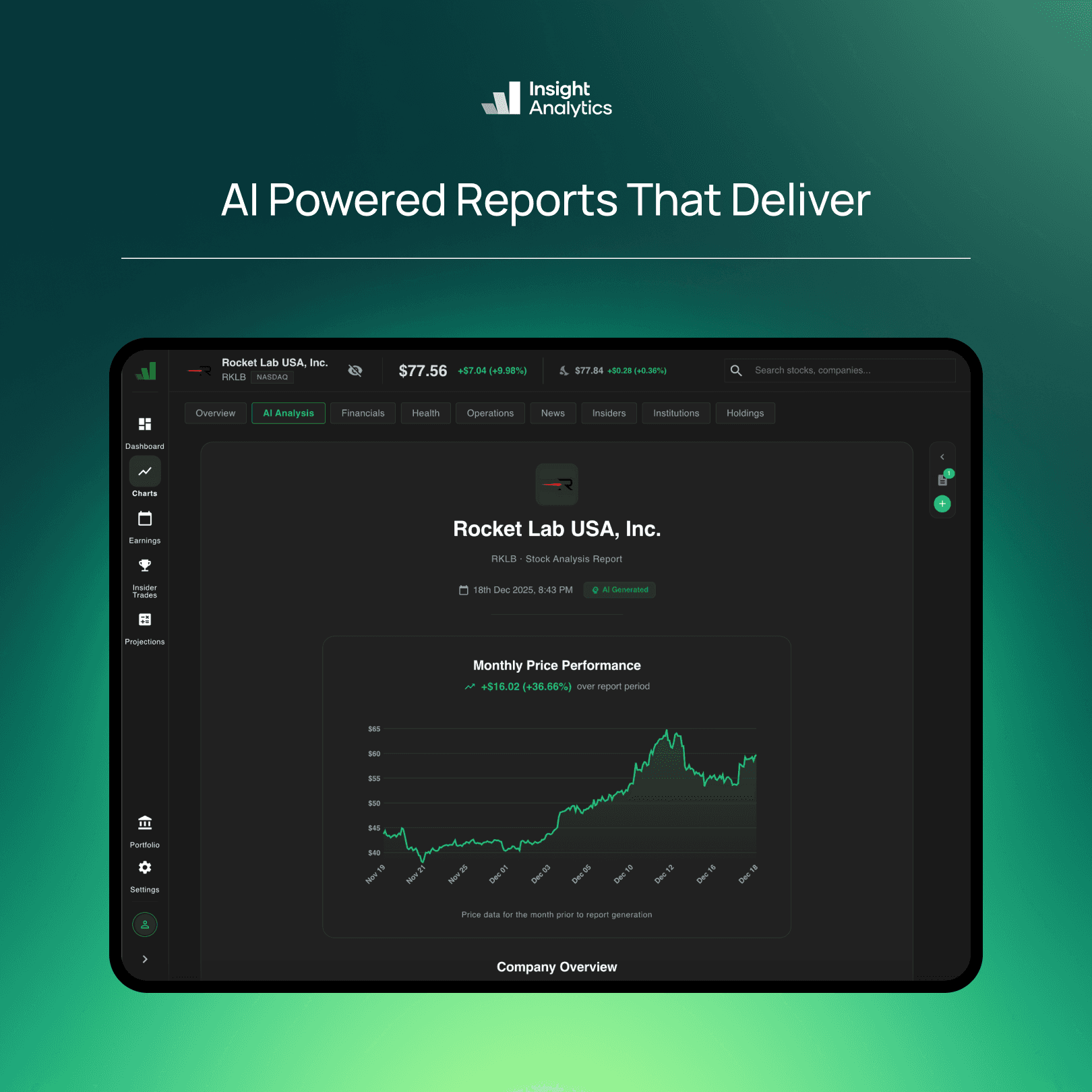
Insight Analytics AI Reports are built to this standard. Each report includes:
Real-Time News Integration
The AI doesn't just analyse historical financials—it pulls the latest news, press releases, and market developments to contextualise the company's current position. An AI report generated today reflects what's happening today, not what happened last quarter.
Comprehensive Financial Analysis
Revenue trends, free cash flow generation, earnings quality, margin trajectory, balance sheet strength—the AI synthesises 30+ years of financial data into a coherent narrative about the company's financial health and trajectory.
Risk Identification
Every investment has risks. Generic AI tools gloss over them. Insight Analytics AI explicitly identifies and explains the key risks facing each company—competitive threats, regulatory exposure, customer concentration, debt concerns, and more.
Competitive Positioning
Where does this company sit within its industry? What are its sustainable advantages? The AI analyses competitive dynamics to help you understand whether the business can maintain its market position.
Analyst Price Target Synthesis
Rather than showing you a list of price targets, the AI synthesises what Wall Street analysts are saying and where consensus expectations sit relative to current prices.
Clear Investment Thesis
Every report concludes with a clear, reasoned investment thesis. Not a buy/sell recommendation—but a comprehensive view of what you're getting if you invest in this company.
This is what AI investing tools should deliver. Anything less is just a fancy search engine.
Why AI Earnings Call Analysis Changes Everything
Earnings calls are gold mines of information—if you have time to listen to 90-minute calls and parse management's carefully worded responses. Most investors don't.
Traditional earnings summaries give you bullet points: "Revenue beat estimates. Management raised guidance. Stock rose 3% after hours."
That tells you nothing about what actually matters.
Insight Analytics AI Earnings Summaries go deeper:
Management Tone and Confidence
The AI analyses not just what management said, but how they said it. Are executives confident or hedging? Are they providing specific guidance or speaking in generalities? These nuances matter.
Strategic Priorities
What is management actually focused on? Cost cutting? Market expansion? New product launches? M&A? The AI extracts the strategic narrative from the noise.
Guidance Context
When management raises or lowers guidance, the AI explains why and what assumptions underpin their outlook. Understanding the "why" behind guidance changes is more valuable than the numbers themselves.
Analyst Question Analysis
The Q&A portion of earnings calls often reveals more than prepared remarks. The AI identifies what analysts are concerned about and how management addresses (or deflects) tough questions.
Quarter-over-Quarter Narrative Changes
Has management's tone shifted from last quarter? Are they emphasising different metrics? The AI tracks how the company's story is evolving over time.
This level of AI earnings analysis transforms how you process information. Instead of spending hours per company, you can develop deep understanding in minutes.
AI-Powered Competitive Analysis: See the Full Picture
Understanding a single company in isolation is like analysing a football team without knowing who they're playing against. Context matters.
Insight Analytics Competitive Analysis uses AI to map each company's competitive landscape:
Industry Positioning
Where does the company rank within its sector? How do its margins, growth rates, and returns compare to peers? The AI builds a comprehensive competitive map.
Sustainable Advantages
Does this company have a moat? The AI analyses factors like brand strength, switching costs, network effects, cost advantages, and regulatory barriers to assess competitive durability.
Threat Assessment
Who are the emerging competitors? What disruptive technologies could impact the business? The AI identifies threats that might not be obvious from financial statements alone.
Relative Valuation Context
Is this stock expensive or cheap relative to competitors with similar characteristics? The AI provides valuation context that helps you understand whether you're paying a premium or getting a discount.
This AI stock picker approach ensures you're never making decisions in a vacuum.
The Difference Between Good and Great AI Stock Analysis
Not all AI investing platforms are equal. Here's what separates surface-level tools from genuine research platforms:
Surface-Level AI | Institutional-Grade AI |
|---|---|
Generic summaries anyone could write | Specific insights tied to financial data |
Static analysis from training data | Real-time news and developments integrated |
Ignores or minimises risks | Explicitly identifies and explains risks |
No competitive context | Full competitive landscape analysis |
Vague conclusions | Clear, reasoned investment thesis |
Same output for every user | Analysis that reflects current market conditions |
When evaluating AI stock analysis tools, ask yourself: "Could I have found this information with a basic Google search?" If yes, the AI isn't adding value.
How AI Analysis Fits Into Your Investment Process
AI doesn't replace investment judgment—it augments it. Here's how serious investors integrate AI research into their workflow:
Screening and Discovery
Use AI reports to quickly evaluate companies that appear on your radar. Rather than spending a full day researching a potential investment, generate an AI report to determine if it warrants deeper investigation.
Earnings Season Efficiency
When your portfolio companies report earnings, AI summaries let you quickly understand results and management commentary. Focus your time on companies where something meaningful changed.
Competitive Due Diligence
Before investing, use AI competitive analysis to understand the industry landscape. Identify whether your target company has sustainable advantages or is vulnerable to disruption.
Ongoing Monitoring
Markets move fast. AI reports generated on demand give you current analysis whenever you need to reassess a position.
Idea Validation
Have a thesis about a company? Generate an AI report to stress-test your thinking. The AI might identify risks or opportunities you hadn't considered.
This is how AI-powered investing creates real edge—not by making decisions for you, but by giving you institutional-quality information to make better decisions yourself.
Why 2026 is the Inflection Point for AI Investing
The AI investing landscape has matured dramatically. Early tools were novelties—impressive demos that fell short in practice. Today's platforms deliver genuine value that rivals professional research.
Several factors are driving this shift:
Better Models
AI models have become dramatically more capable at financial analysis. They can now synthesise complex, multi-factor situations that earlier models couldn't handle.
Real-Time Data Integration
Modern AI platforms pull live data rather than relying solely on training data. This means analysis reflects current market conditions, not stale information.
Domain Specialisation
General-purpose AI assistants struggle with investment research. Purpose-built platforms like Insight Analytics are trained specifically on financial analysis, producing more relevant and accurate outputs.
Cost Efficiency
Running sophisticated AI analysis has become affordable enough to offer at retail price points. Features that would have cost thousands per month two years ago are now accessible to individual investors.
The result: AI stock picking has moved from "interesting experiment" to "essential tool" for serious investors.
Getting Started with AI-Powered Stock Research
If you're ready to experience what institutional-grade AI analysis looks like, here's how to begin:
1. Generate Your First AI Report
Pick a company you're considering for investment. Generate a comprehensive AI report and compare it to your existing research. Notice what the AI surfaces that you might have missed.
2. Review Earnings Summaries for Your Holdings
For companies you already own, read the AI earnings summaries from recent quarters. Develop a richer understanding of what management is focused on and how the business is evolving.
3. Explore Competitive Analysis
For your highest-conviction positions, dive into competitive analysis. Understand where your companies sit within their industries and what threatens their market positions.
4. Build AI Research into Your Routine
Make AI analysis a standard part of your investment process. Generate reports before making buy/sell decisions. Review earnings summaries within hours of calls rather than days.
Conclusion: The New Standard for Investment Research
The information advantage that institutional investors held for decades is eroding. AI stock analysis now puts hedge fund-level research in the hands of individual investors.
But quality matters. Surface-level summaries waste your time. You need AI that delivers:
Comprehensive reports pulling real-time news and 30+ years of financial data
Deep earnings analysis that goes beyond bullet points to genuine understanding
Competitive intelligence that contextualises every investment within its industry
Insight Analytics was built to this standard. Every AI feature is designed to give you the depth and nuance that actually improves investment decisions—not just impressive demos that fall short in practice.
The future of investing is AI-augmented. The question is whether you'll have access to the best AI tools—or be left behind by those who do.